Outsourcing QA Vs In-House QA: Which One Is Actually Right for Your Business?

TL;DR :-
Compare outsourcing QA vs in house QA across cost, scalability, delivery speed, expertise access, and long-term product ownership considerations.
Understand real advantages, risks, hybrid models, and decision frameworks used by engineering leaders to choose the right QA strategy.
Discover practical evaluation steps, side-by-side comparisons, and proven approaches to build scalable, high-quality software testing operations.
Software releases are getting faster, but QA decisions are getting harder. Engineering leaders constantly face the same question: build an internal QA team or outsource testing expertise?
The wrong choice slows releases, increases defect leakage, and drains engineering budgets. Many companies invest heavily in hiring testers only to discover scalability problems during product growth.
Others outsource too early and lose domain alignment. The real challenge isn’t choosing a popular model; it’s choosing the right QA operating strategy for your business stage, delivery velocity, and product complexity.
This guide breaks down both approaches clearly so you can decide with confidence.
The Quick Snapshot
Before diving deeper, it helps to compare both QA approaches at a glance. This snapshot highlights operational differences executives evaluate first when assessing testing strategy and delivery readiness.
Factor | In-House QA | Outsourced QA |
Cost | Fixed salaries, infrastructure, hiring overhead | Variable engagement-based cost |
Speed to Start | 60–90 day hiring cycle | Immediate onboarding |
Domain Knowledge | Deep internal understanding | Requires onboarding but scalable expertise |
Coverage Flexibility | Limited by team size | High flexibility across platforms |
Accountability | Direct managerial control | SLA-based accountability |
Tooling & Process | Built internally | Mature frameworks already available |
Right For | Stable long-term products | Scaling teams and rapid releases |
This comparison shows why QA decisions increasingly move from HR discussions to executive-level engineering strategy conversations.
Upgrade Your Testing Strategy Today
Modern software demands continuous testing and automation maturity. Soft Suave aligns QA engineering with agile workflows, ensuring seamless collaboration, faster releases, and stronger customer experiences.
Explore QA
In-House QA: What You’re Really Signing Up For
Building an internal QA team offers control and alignment, but it also introduces operational commitments that many companies underestimate. Understanding both advantages and constraints prevents costly hiring decisions later.
Advantages of In-House QA

Deep Product Knowledge: Internal testers grow alongside engineering teams. They understand architecture decisions, legacy dependencies, and business workflows deeply, improving long-term regression accuracy and collaboration efficiency across agile sprint cycles.
Direct Communication and Control: In-house teams sit within daily standups, sprint reviews, and release planning. This reduces communication delays and allows immediate prioritization adjustments when product owners or architects change delivery direction.
Strong Security and IP Confidence: Organizations handling sensitive financial, healthcare, or enterprise data often prefer internal QA ownership to maintain tighter governance, compliance monitoring, and direct security oversight.
Challenges Often Overlooked
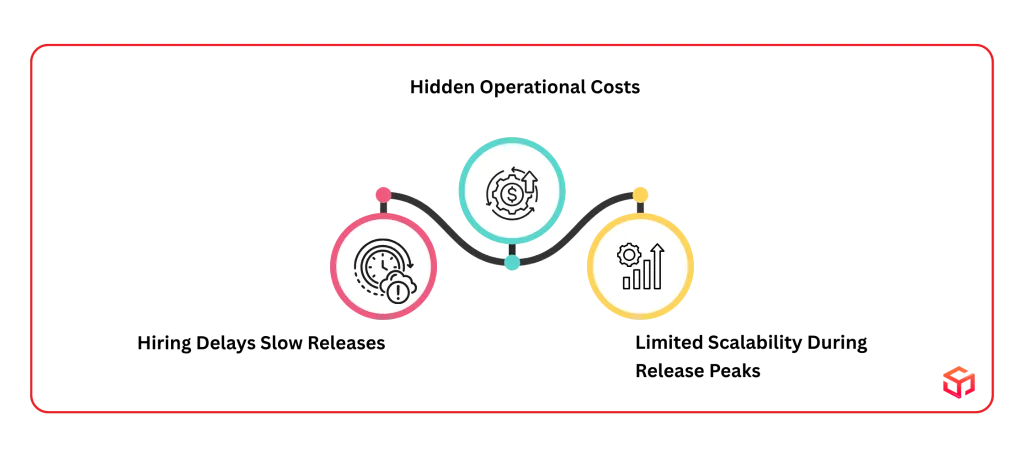
Hiring Delays Slow Releases: Recruiting skilled QA engineers or automation specialists can take months. During scaling phases, engineering teams frequently ship features faster than testing capacity grows.
Hidden Operational Costs: Salary is only part of the investment. Companies must fund tools, environments, device labs, automation infrastructure, training programs, and ongoing management overhead.
Limited Scalability During Release Peaks: Internal teams struggle during product launches or large regression cycles. Scaling temporarily requires expensive hiring decisions that may not remain justified after delivery stabilizes.
Outsourced QA: What You’re Really Getting
Outsourcing QA is often misunderstood as simply reducing cost. In reality, it shifts testing from a staffing problem into a scalable engineering capability built around delivery speed and specialization.
Key Advantages of Outsourced QA
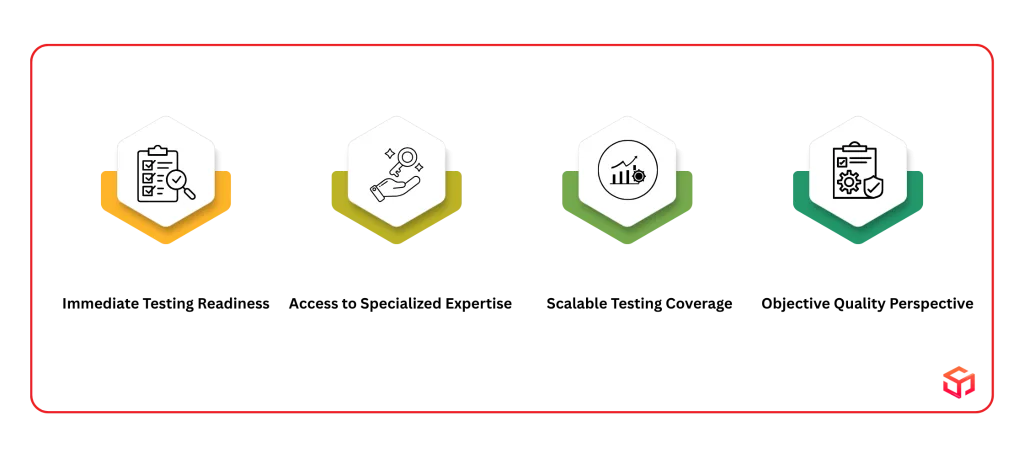
Immediate Testing Readiness: Experienced vendors provide trained engineers, established workflows, and ready automation frameworks. Testing can begin within days rather than waiting through recruitment cycles.
Access to Specialized Expertise: Outsourced teams bring performance testing specialists, security testers, automation engineers, and cross-platform experts who would be expensive to maintain internally full-time.
Scalable Testing Coverage: External teams expand quickly during release surges, regression cycles, or multi-device testing phases, enabling continuous delivery without overburdening internal engineering teams.
Objective Quality Perspective: Independent QA teams identify usability gaps and edge-case defects that internal teams may overlook due to product familiarity or deadline pressure.
Potential Trade-Offs
Initial Domain Learning Curve: External teams require onboarding to understand workflows, users, and business logic. Strong documentation and collaboration reduce this ramp-up period significantly.
Vendor Selection Matters: Success depends heavily on choosing partners with proven QA frameworks, governance models, and transparent reporting structures aligned with agile delivery practices.
Outsourced QA works best when treated as an engineering partnership rather than a transactional service.
Test Our QA Experts Risk-Free Today
Evaluate Soft Suave engineers through a 40-hour free trial. Experience real delivery results, collaboration quality, and technical expertise before making any long-term commitment.
Get Started FreeWhich Model Is Right for You?
Choosing between outsourcing and in-house QA becomes clearer when mapped against business realities instead of personal preference. The following framework helps leadership teams evaluate alignment.
Question | If Your Answer Is… | Go With |
Are releases frequent and fast? | Yes | Outsourced QA |
Is product knowledge critical? | Yes | In-House QA |
Do workloads fluctuate? | Yes | Outsourced QA |
Is hiring slow or costly? | Yes | Outsourced QA |
Do you need long-term ownership? | Yes | In-House QA |
Are specialized testing skills required? | Yes | Outsourced QA |
Is your roadmap stable and predictable? | Yes | In-House QA |
Growing companies often realize that QA strategy evolves similarly to architecture decisions. Early-stage startups prioritize speed, while mature platforms value internal knowledge retention.
Head-to-Head: Full Comparison
A deeper comparison helps engineering leaders evaluate operational impact beyond surface-level differences. Each factor below directly influences release stability and organizational scalability.
Factor | In-House QA | Outsourced QA |
Annual cost per QA engineer | High fixed cost | Flexible engagement cost |
Time to first active testing | Months | Days or weeks |
Scalability for release peaks | Limited | Rapid expansion |
Domain knowledge depth | High | Moderate initially |
Fresh perspective on bugs | Lower | High |
Specialist skill access | Limited | Extensive |
Process and tooling | Built internally | Mature frameworks ready |
Accountability structure | Direct reporting | SLA-driven governance |
IP and data security | Full internal control | Controlled access protocols |
Right team size | Stable organizations | Scaling businesses |
This comparison illustrates why modern QA decisions increasingly focus on testing scalability and engineering efficiency rather than simple cost comparisons.
What About a Hybrid Model?
Many organizations discover the debate isn’t about choosing one model exclusively. Hybrid QA strategies combine internal knowledge ownership with outsourced scalability to support evolving product delivery needs.
A hybrid model typically works like this:
Core Internal QA Team: Maintains domain expertise, defines testing strategy, and collaborates closely with product managers and architects to ensure alignment with long-term roadmap priorities.
External QA for Scale and Specialization: Handles automation expansion, regression cycles, performance testing, or release crunch periods without forcing permanent hiring commitments.
Balanced Cost and Risk Management: Organizations avoid overstaffing while maintaining delivery continuity. This approach improves release velocity while protecting institutional knowledge.
Hybrid QA increasingly represents the modern software quality assurance strategy adopted by scaling SaaS and enterprise platforms.
How Soft Suave Handles QA Outsourcing
Choosing the right partner matters as much as choosing the right model. Soft Suave approaches QA as an integrated engineering function rather than an isolated testing activity.
Soft Suave supports organizations through flexible engagement models aligned with real delivery workflows:
Dedicated QA Teams: Engineers integrate directly into agile squads, participate in sprint ceremonies, and align with DevOps pipelines to maintain continuous testing throughout the product lifecycle.
Staff Augmentation for Specialized Needs: Companies requiring automation acceleration or short-term scaling benefit from their test automation & QA IT staff augmentation, enabling immediate capability expansion without disrupting internal structures.
Process-Driven Quality Engineering: Soft Suave emphasizes automation maturity, risk mitigation frameworks, and performance validation practices that strengthen engineering efficiency and reduce production defects.
This balanced approach ensures clients retain strategic control while gaining scalable execution power.
Build QA Power Without Hiring Confusion
Access automation specialists, performance testers, and DevOps-ready QA engineers aligned with modern delivery pipelines, helping your teams release faster while maintaining enterprise-grade product stability.
Start NowReady to Fix Your QA? Here’s How to Start
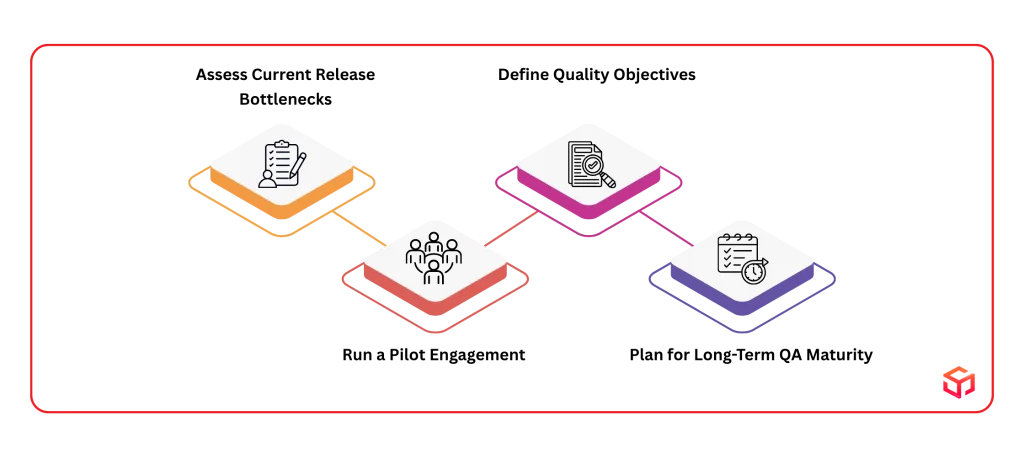
Selecting a QA model becomes easier when approached systematically. Instead of debating theory, organizations should evaluate operational readiness and delivery goals step by step.
Assess Current Release Bottlenecks
Identify where delays occur—manual testing, environment setup, automation gaps, or staffing limitations. Understanding constraints clarifies whether scaling people, process, or expertise solves the problem.Define Quality Objectives
Align QA strategy with business outcomes such as faster releases, reduced production defects, or improved customer experience rather than focusing solely on staffing models.Run a Pilot Engagement
Many companies validate outsourcing success through small trial projects before expanding engagement scope, reducing risk while evaluating collaboration effectiveness.Plan for Long-Term QA Maturity
The goal isn’t short-term testing support. It’s building a sustainable quality engineering ecosystem supporting continuous delivery and evolving product architectures.
Conclusion
Quality engineering decisions shape how fast your software evolves. The right QA model accelerates delivery, reduces operational risk, and strengthens customer trust.
Companies that treat QA as a strategic capability outperform competitors who still view testing as a cost center. Whether you build internal expertise, partner with external specialists, or adopt a hybrid strategy, the goal remains the same—consistent, scalable software quality.
Evaluate your current bottlenecks, align QA with business growth, and move toward a model that supports continuous innovation rather than slowing it down. The sooner your QA strategy evolves, the faster your product can compete and win.
FAQs
Which is faster to scale: outsourced QA or in-house QA?
Outsourced QA scales significantly faster because trained teams and established processes already exist. Companies can expand testing coverage immediately without waiting for recruitment, onboarding, or internal infrastructure setup.
Can companies use a hybrid model with both in-house and outsourced QA?
Yes. Many organizations maintain a core internal QA team for domain expertise while outsourcing regression, automation, or performance testing to achieve flexibility without sacrificing product ownership.
How do I decide between outsourced QA and in-house QA for my business?
Evaluate release frequency, hiring capacity, budget flexibility, and product complexity. Fast-growing teams benefit from outsourcing, while stable platforms with deep domain logic often prefer internal QA ownership.
What is the difference between outsourced QA and in-house QA?
In-house QA relies on internally hired testers working closely with development teams. Outsourced QA provides external specialists, scalable testing resources, and mature processes managed through service-level agreements.
When is outsourced QA the better choice?
Outsourcing works best during rapid scaling, tight delivery timelines, multi-platform testing needs, or when organizations lack automation expertise but need immediate quality engineering capabilities.
Does outsourced QA affect product quality compared to in-house QA?
When managed properly, outsourced QA often improves quality by introducing specialized expertise, structured testing methodologies, and unbiased validation that complements internal development perspectives.
Related Blogs